Turning a standard event venue into a mesmerising spectacle often feels just out of reach, but projection mapping paired with mirror balls is changing what is possible. For British event planners and venue owners, the creative drive to stand out means exploring new tools that redefine audience engagement. This guide uncovers how projection mapping with mirror balls does more than add decoration, offering truly immersive visual storytelling and practical insights for transforming any gathering into an unforgettable experience.
Table of Contents
- Projection Mapping Defined And Common Myths
- Core Technologies And How It Works
- Types Of Projection Mapping For Events
- Using Projection Mapping With Mirror Balls
- Costs, Setup Risks, And Event Considerations
Key Takeaways
| Point | Details |
|---|---|
| Understanding Projection Mapping | It is a sophisticated technique that transforms physical surfaces into dynamic visual displays, enhancing storytelling and viewer engagement. |
| Common Misconceptions | Projection mapping is often misunderstood as merely decorative and overly complex, while its potential extends across various sectors, making it accessible for different applications. |
| Technological Components | Key elements include high-resolution projectors, advanced mapping software, and calibration systems, which are crucial for achieving quality visuals and seamless integration. |
| Budget Considerations | Planning requires careful financial management, with costs ranging significantly based on equipment, complexity, and potential risks due to environmental factors. |
Projection Mapping Defined And Common Myths
Projection mapping represents a sophisticated digital art form that transcends traditional visual presentation techniques. Innovative spatial transformation techniques challenge conventional perceptions of image projection by dynamically integrating digital imagery with three-dimensional surfaces.
At its core, projection mapping involves digitally projecting visual content onto physical surfaces, creating immersive and transformative experiences. Unlike standard projection methods, this technique manipulates imagery to perfectly align with architectural forms, sculptures, or stage designs. The technology essentially turns any surface into a potential canvas, enabling remarkable visual storytelling.
Common myths about projection mapping often misunderstand its complexity and potential. Here are key misconceptions:
- Myth: Projection mapping is just a decorative technique
- Myth: It only works with perfectly smooth surfaces
- Myth: The technology is prohibitively expensive for most venues
- Myth: Complex setups require extensive technical expertise
Digital media art practices demonstrate that projection mapping fundamentally reconstructs relationships between images, surfaces, and spatial experiences. By disassembling traditional screen concepts, this technology creates augmented environments that offer unique narrative possibilities.
The technique’s versatility extends across multiple sectors, including entertainment, advertising, museum exhibitions, and corporate events. Event planners can utilise projection mapping to transform ordinary venues into extraordinary experiences, making each space tell a dynamic, engaging story.
Pro tip: When considering projection mapping, always conduct a thorough venue surface assessment to determine optimal projection opportunities and potential visual challenges.
Core Technologies And How It Works
Projection mapping relies on sophisticated technological infrastructure that transforms ordinary surfaces into dynamic visual canvases. Cutting-edge projection technologies enable precise digital content alignment with three-dimensional environments, creating immersive visual experiences.
The core technological components of projection mapping include several critical elements:
- High-resolution digital projectors
- Advanced mapping software platforms
- Geometric calibration systems
- Content management and rendering hardware
- Specialised projection alignment tools
Technical challenges in projection mapping encompass multiple complex considerations. Professionals must navigate intricate technical requirements such as geometric registration, radiometric compensation, and shadow removal to achieve seamless visual integration.
The technical workflow typically involves several systematic stages. First, technicians capture detailed surface topography using specialised scanning techniques. Next, digital content is precisely mapped and warped to match the specific geometric characteristics of the target surface. Sophisticated software like TouchDesigner and MadMapper allows granular content manipulation, enabling remarkable visual transformations.
Modern projection mapping technologies support diverse application scenarios across entertainment, advertising, museums, and corporate environments. The ability to transform static surfaces into dynamic storytelling platforms makes this technology increasingly valuable for creative professionals seeking innovative visual communication methods.
Pro tip: Invest in high-quality calibration equipment and conduct thorough surface scanning to ensure optimal projection mapping results.
Types Of Projection Mapping For Events
Projection mapping offers event professionals a versatile range of transformative visual techniques that can dramatically enhance audience experiences. Comprehensive projection mapping applications reveal multiple strategic approaches tailored to different event environments and creative objectives.
The primary types of projection mapping for events include:
- Facade Mapping: Large-scale projections onto building exteriors
- Stage Mapping: Dynamic visual backgrounds for concerts and theatrical performances
- Object Mapping: Transforming three-dimensional sculptures and physical objects
- 360-Degree Immersive Mapping: Complete environmental visual transformations
- Interactive Installation Mapping: Audience-responsive projection experiences
Event projection mapping strategies demonstrate remarkable versatility across different event categories. Corporate events might utilise precise object mapping to highlight product launches, while music festivals could employ expansive facade mapping to create stunning visual spectacles.
Technical considerations vary significantly between mapping types. Facade mapping requires powerful high-lumens projectors and complex geometric calibration, whereas object mapping demands precise surface scanning and content warping techniques. Interactive installations introduce additional complexity by incorporating real-time audience tracking and responsive visual systems.
Modern event designers increasingly view projection mapping as a storytelling medium, using visual transformations to communicate narratives, enhance brand experiences, and create memorable audience interactions. The technology bridges physical and digital realms, turning static environments into dynamic, engaging canvases.
Here’s a summary of key projection mapping types and their unique event applications:
| Mapping Type | Ideal Use Case | Key Visual Impact |
|---|---|---|
| Facade Mapping | Outdoor festivals, city events | Dramatic building displays |
| Stage Mapping | Concerts, theatre shows | Immersive set backgrounds |
| Object Mapping | Product launches, museums | Product highlight effects |
| 360-Degree Immersive | Brand experiences, expo booths | Surround audience visuals |
| Interactive Installation | Art shows, tech expos | Real-time audience input |
Pro tip: Always conduct thorough venue site surveys and technical rehearsals to ensure seamless projection mapping integration and optimal visual impact.
Using Projection Mapping With Mirror Balls
Projection mapping and mirror balls represent a powerful combination for creating immersive visual experiences. Spherical mirror projection techniques offer unique opportunities for capturing wide-angle and panoramic visual effects in event environments.
Key strategies for integrating mirror balls with projection mapping include:
- Reflection Amplification: Using mirror balls to multiply and distribute projected imagery
- Omnidirectional Visual Effects: Creating 360-degree immersive experiences
- Spatial Distortion Techniques: Manipulating light and reflection patterns
- Multi-Angle Projection: Leveraging mirror ball surfaces for complex visual narratives
- Depth Perception Enhancement: Using reflective surfaces to create visual depth
The technical integration requires precise calibration and strategic positioning. Mirror balls can transform standard projections by fragmenting and redistributing light across multiple angles, creating kaleidoscopic visual experiences that engage audiences from every perspective.
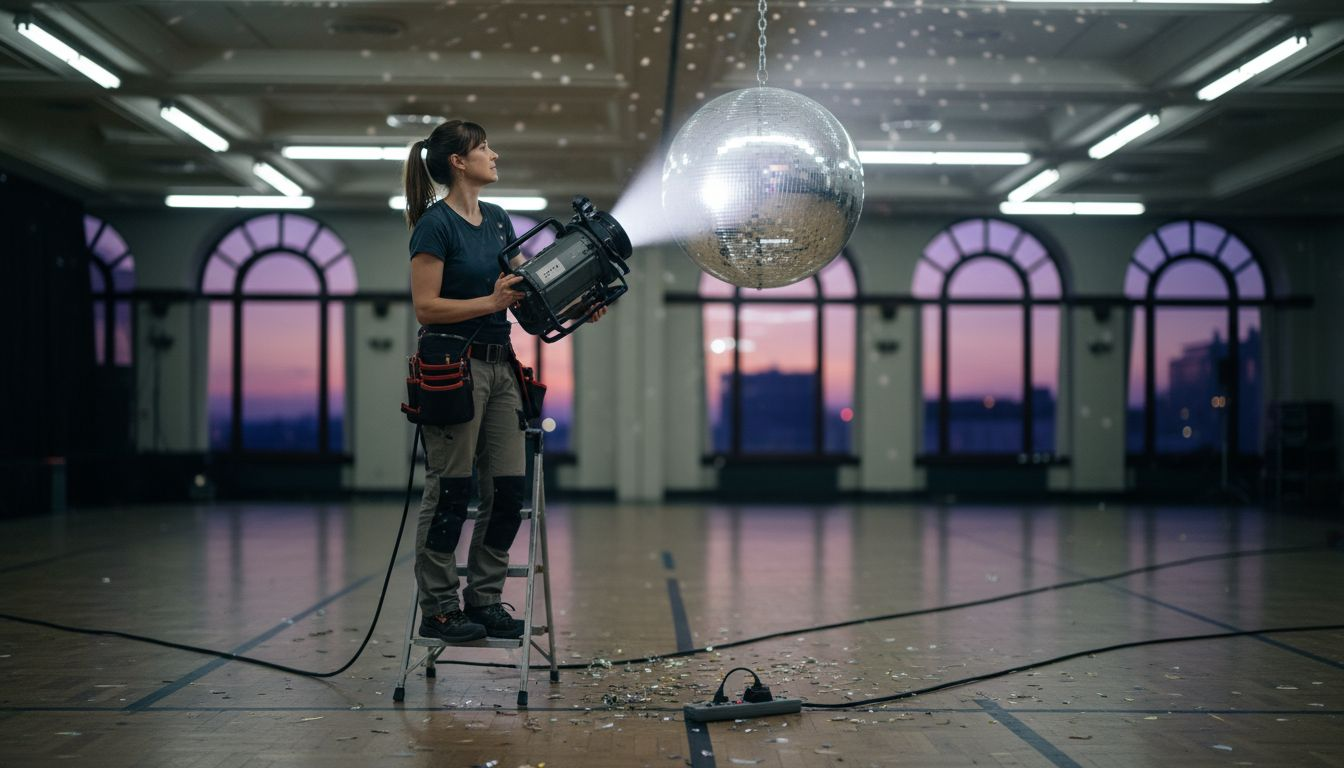
Event designers can utilise mirror balls as dynamic projection surfaces, breaking traditional projection mapping constraints. By understanding how reflective spheres interact with light and digital content, professionals can create multilayered visual experiences that transcend conventional projection techniques.
Venue creative mirror ball techniques demonstrate the potential for innovative visual storytelling, turning static environments into dynamic, interactive landscapes that capture audience imagination.
Pro tip: Experiment with multiple projector angles and mirror ball positions during technical rehearsals to discover unexpected and stunning visual combinations.
Costs, Setup Risks, And Event Considerations
Projection mapping represents a sophisticated technology with significant financial and technical considerations for event professionals. Projection mapping cost factors require comprehensive understanding to ensure successful implementation and budget management.
Key financial and technical considerations include:
- Equipment Investment: Projector costs ranging from £2,000-£20,000
- Surface Complexity: Additional expenses for specialised mapping software
- Labour Costs: Professional technician fees for setup and calibration
- Venue Lighting Modifications: Potential additional expenses for optimal projection conditions
- Content Creation: Digital design and animation development costs
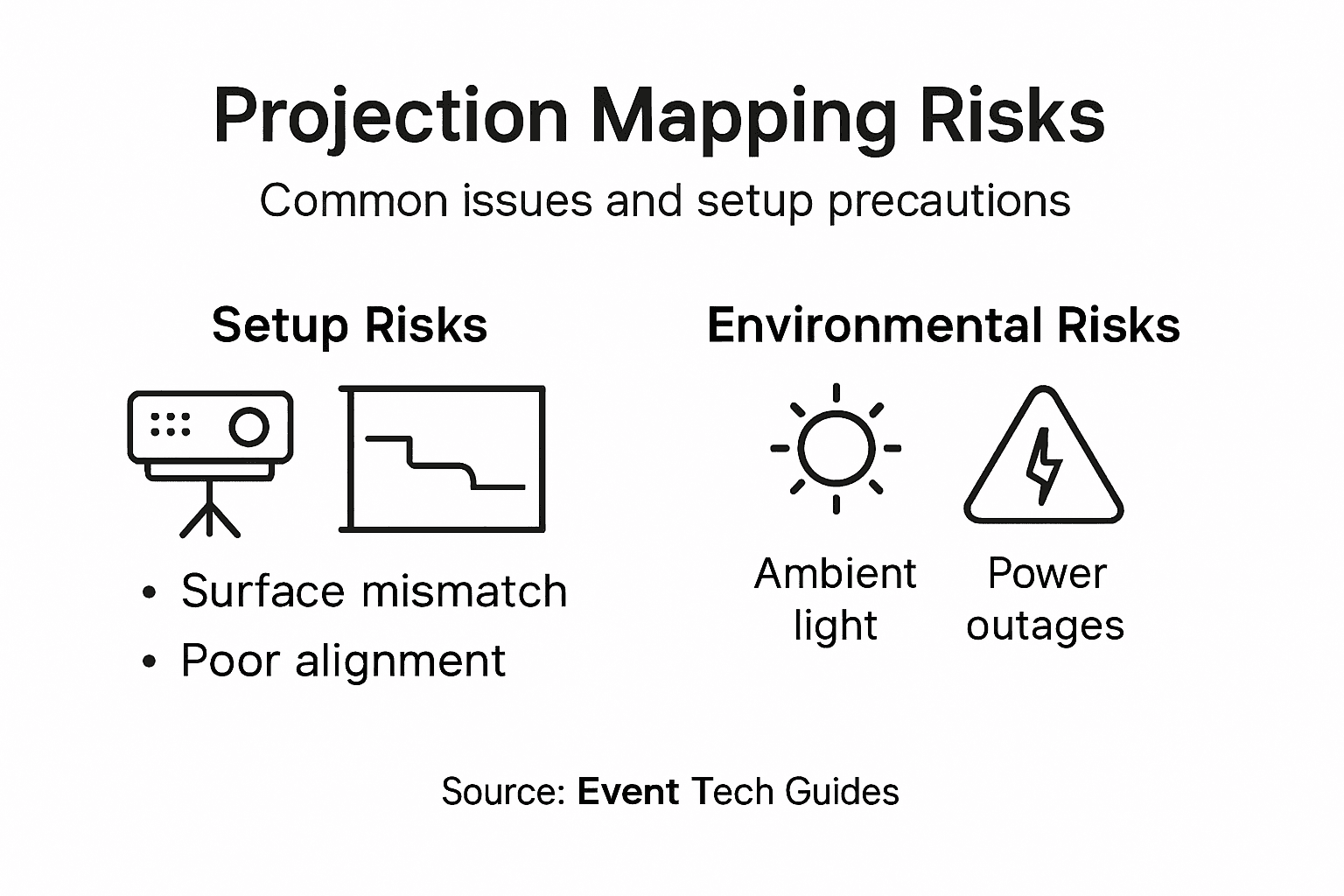
Event projection mapping risks demand meticulous planning and technical expertise. Environmental factors such as ambient light, surface texture, and audience positioning dramatically impact projection quality and overall visual performance.
Technical setup risks require strategic mitigation strategies. Event planners must consider projector placement, surface material compatibility, potential signal interference, and real-time calibration challenges. Successful implementation demands precise technical knowledge and flexible contingency planning.
Budget allocation should typically represent 15-25% of total event production costs, with significant variation depending on project complexity and desired visual sophistication. Smaller venues might achieve impressive results with more modest investments, while large-scale productions require substantial technical infrastructure.
To help budget and plan for projection mapping, here is a comparison of common expenses and their potential risks:
| Cost Factor | Typical Price Range | Main Setup Risk |
|---|---|---|
| Projector Equipment | £2,000 – £20,000 | Inadequate brightness or failure |
| Mapping Software | £500 – £5,000 | Compatibility with hardware |
| Technicians | £400 – £2,500 | Insufficient expertise |
| Venue Adaptations | £300 – £4,000 | Poor ambient light control |
| Content Creation | £1,000 – £10,000 | Delays in animation delivery |
Pro tip: Allocate at least 20% of your projection mapping budget for unexpected technical contingencies and professional calibration services.
Elevate Your Venue with Mirror Balls and Projection Mapping
Projection mapping redefines event spaces by transforming every surface into a dynamic visual story. One challenge highlighted in the article is achieving truly immersive and multidimensional lighting effects that captivate audiences from every angle. By combining the power of projection mapping with high-quality mirror balls, you can amplify reflections and create mesmerizing, omni-directional visuals that breathe life into any venue. This blend addresses key pain points such as spatial distortion, depth perception enhancement, and the desire to move beyond flat projections.
Discover how professional-grade mirror balls serve as perfect canvases for projection mapping techniques, multiplying light and creating kaleidoscopic effects that elevate entertainment experiences. Whether you are planning a nightclub event, theatre production, or a corporate celebration, integrating mirror balls unleashes new creative possibilities while managing technical risks like light fragmentation and calibration challenges.
Are you ready to enrich your projection mapping setup with stunning reflective surfaces and captivate your audience like never before
Explore our versatile range of mirror balls and accessories at Mirror Balls UK. Act now to transform your venue into a spectacular visual playground that offers unforgettable experiences. Visit us today and unlock innovative visual storytelling solutions for your next event.
Frequently Asked Questions
What is projection mapping?
Projection mapping is a digital art form that involves projecting visual content onto physical surfaces to create immersive and transformative experiences. It aligns digital imagery with three-dimensional objects or architectural structures, turning any surface into a potential canvas for storytelling.
What are the common types of projection mapping used in events?
The main types of projection mapping for events include facade mapping, stage mapping, object mapping, 360-degree immersive mapping, and interactive installation mapping. Each type serves different purposes, allowing event professionals to tailor visual experiences to their specific audience and venue.
What are the key technological components required for projection mapping?
Key technological components for projection mapping include high-resolution digital projectors, advanced mapping software, geometric calibration systems, content management hardware, and specialised projection alignment tools. These elements work together to ensure precise digital content alignment with physical surfaces.
What should I consider when budgeting for projection mapping in events?
When budgeting for projection mapping, consider factors such as equipment investment (projectors and mapping software), labour costs for technicians, venue lighting modifications, and content creation expenses. It’s advisable to allocate 15-25% of your total event production costs to projection mapping, accounting for potential technical contingencies.