One spinning mirror ball can send hundreds of sparkling lights across every surface, creating a visual spectacle that has mesmerized partygoers for decades. More than just party decor, these glittering spheres work through precise optics and careful engineering. Understanding the science behind how they break up a single beam of light into countless moving reflections can transform the way you create unforgettable atmospheres with lighting effects.
Table of Contents
- How Mirror Balls Diffuse Light Explained
- Science Behind Mirror Ball Light Effects
- Types of Mirror Balls and Their Differences
- Practical Applications in Venues and Events
- Common Setup Pitfalls and How to Avoid Them
Key Takeaways
| Point | Details |
|---|---|
| Light Reflection Mechanism | Mirror balls utilize specular reflection, transforming incoming light into dynamic patterns that enhance visual experiences. |
| Types and Uses | Different mirror ball sizes and construction types are suitable for various settings, from intimate home use to large theatrical productions. |
| Installation Best Practices | Successful setups require careful planning, including proper lighting angles, motor control, and safety measures to achieve optimal effects. |
| Event Transformation | Mirror balls are versatile tools in event design, capable of creating both subtle atmospheres and vibrant displays through precise light manipulation. |
How Mirror Balls Diffuse Light Explained
Mirror balls transform ordinary lighting into extraordinary visual experiences through a fascinating process of light reflection. As detailed by Wikipedia, these spherical objects are covered in numerous small mirrored facets that perform an intricate dance of illumination when struck by spotlights.
The magic happens through a precise optical phenomenon called specular reflection. According to Deakin University, this type of reflection occurs when light bounces off surfaces in an orderly, predictable manner – precisely how mirror balls operate. Each tiny mirrored surface acts like a miniature precision mirror, capturing incoming light and projecting it outwards at carefully calculated angles.
When a spotlight hits a mirror ball, something remarkable occurs. Instead of reflecting light in a single direction, the ball’s hundreds or thousands of tiny mirrored facets each reflect light independently. This creates a mesmerising effect where light fragments into countless small, moving points that dance across walls, floors, and ceilings. The result is a dynamic, shimmering display that can transform any space from ordinary to extraordinary.
Light diffusion through mirror balls isn’t random – it’s a carefully engineered optical performance. By strategically positioning the ball and controlling the light source, event designers and lighting technicians can create everything from subtle atmospheric effects to dramatic, pulse-quickening light shows. 7 Examples of Mirror Ball Effects for Stunning Events provides an excellent deep dive into the creative possibilities of these remarkable lighting tools.
Science Behind Mirror Ball Light Effects
Light physics transform mirror balls into mesmerising visual instruments through a complex interplay of optical principles. As Wikipedia explains, these spherical devices are engineered to reflect light beams in multiple directions, creating dynamic patterns that captivate audiences across various settings.
The scientific mechanism relies on precise geometric reflection. Each tiny mirrored facet acts like an independent optical element, capturing and redirecting light with mathematical precision. When a light source illuminates the ball, hundreds of miniature mirrors simultaneously bounce light at different angles, generating a shimmering, ever-changing display that seems to dance across surrounding surfaces.
Motion plays a crucial role in amplifying these light effects. Mirror Balls notes that electric motors enable consistent, smooth circular rotation, which dramatically enhances the light projection. As the ball slowly rotates, its reflected light points continuously shift, creating an illusion of liquid movement that transforms static environments into dynamic, immersive experiences.
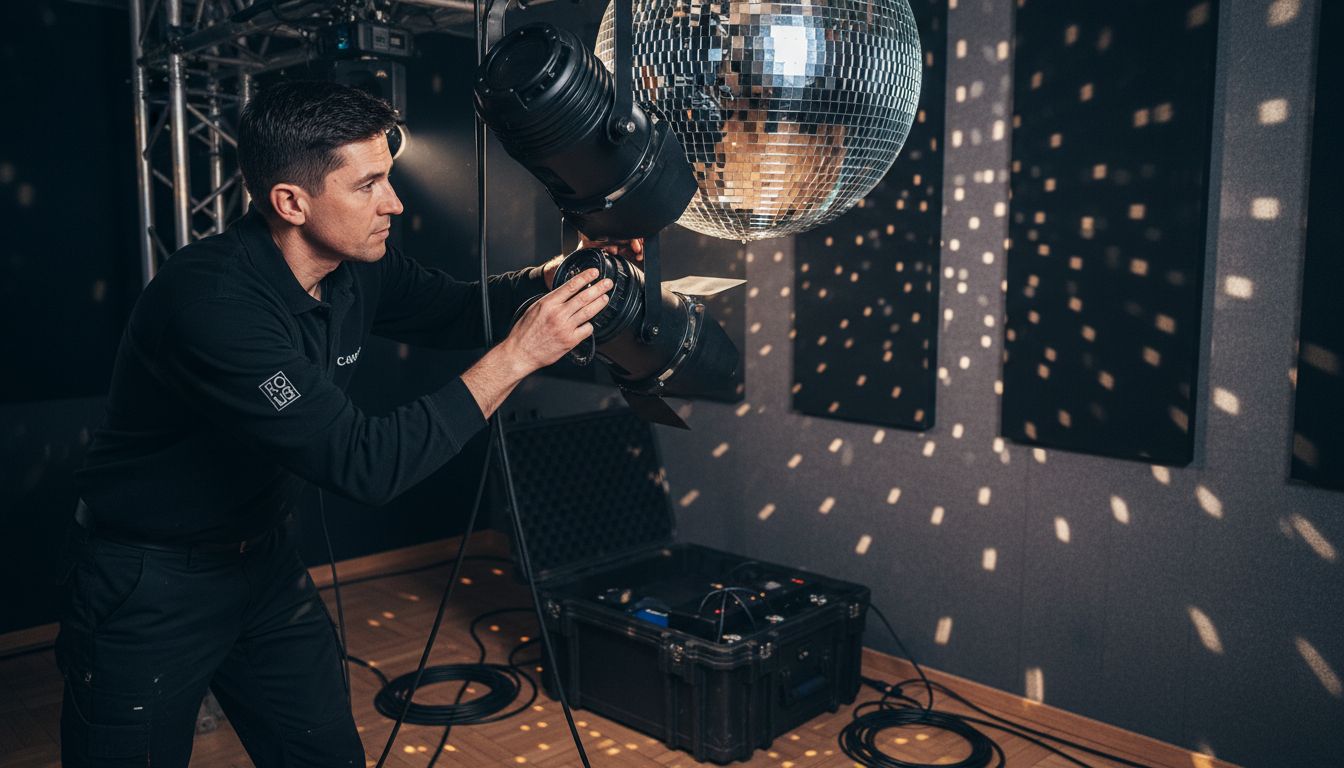
Understanding these scientific principles allows event designers and lighting professionals to manipulate mirror ball effects with incredible sophistication. By strategically positioning light sources and controlling rotation speed, they can engineer everything from subtle, atmospheric glimmers to intense, pulsating light shows. For professionals seeking deeper insights, our guide on mirror balls for events offers comprehensive techniques for maximising these remarkable optical instruments.
Types of Mirror Balls and Their Differences
Mirror balls come in a fascinating array of sizes and specifications, each designed to create unique lighting experiences. Mirror-Balls.co.uk reveals that these versatile spheres typically range from compact 5 cm models to impressive 200 cm diameter installations, offering remarkable flexibility for different venue requirements.
The construction complexity of mirror balls varies significantly. Some feature plastic cores for lightweight applications, while others use robust aluminum bases for more demanding professional settings. The mirrored facets themselves are equally diverse, with tile sizes ranging from precise 5×5 mm squares to larger 10×10 mm panels. These variations dramatically impact the light reflection characteristics, creating everything from subtle, refined shimmer to intense, explosive light displays.
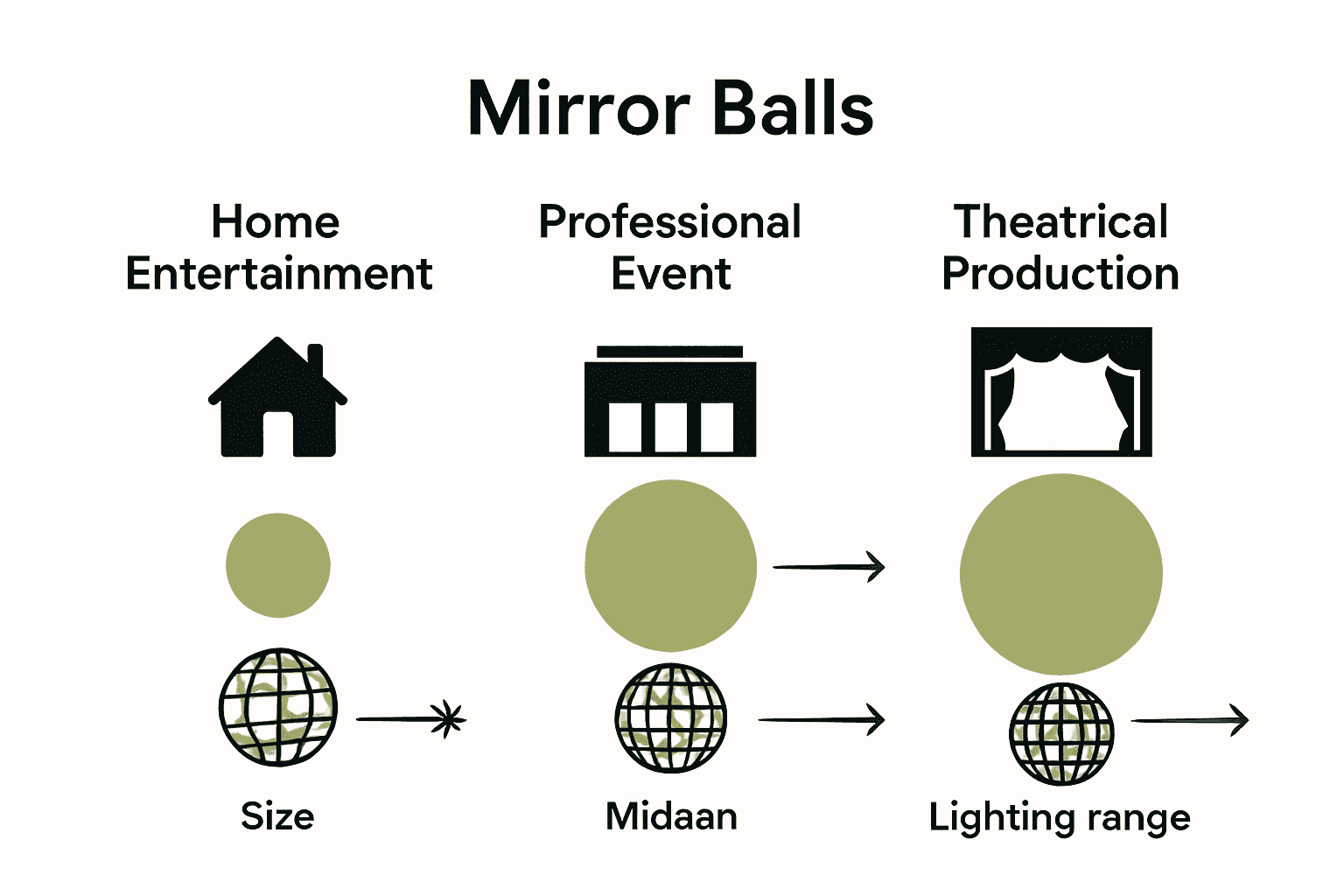
Specialists typically categorize mirror balls into three primary performance tiers: home entertainment, professional event, and theatrical production. Home-use balls tend to be smaller, more affordable, and designed for intimate spaces. Professional event mirror balls offer enhanced rotation mechanisms and superior light dispersion, making them ideal for large venues.
Theatrical production mirror balls represent the pinnacle of engineering, featuring custom motor systems, precision-cut mirrored surfaces, and extraordinary light manipulation capabilities.
Here’s a comparison of the main types of mirror balls and their characteristics:
| Type | Typical Size Range | Construction Features | Light Effect Style |
|---|---|---|---|
| Home Entertainment | 5–30 cm | Plastic core Basic tiling |
Subtle shimmer Intimate spaces |
| Professional Event | 30–50 cm | Plastic core Fine tiling |
Enhanced reflection Larger venues |
| Theatrical Production | 60–200 cm | Fibre-Glass core Precision mirrors |
Dramatic Custom light shows |
For event planners and lighting designers seeking the perfect mirror ball, careful selection is crucial. 7 Best Mirror Ball Sizes for Every Event and Venue provides comprehensive guidance on matching mirror ball specifications to specific environmental and performance requirements. Whether you’re creating a subtle background ambiance or designing a spectacular light show, understanding these nuanced differences ensures you select the most appropriate mirror ball for your unique application.
Practical Applications in Venues and Events
Atmospheric transformation is the hallmark of mirror ball applications across diverse event environments. As Wikipedia explains, these remarkable devices are particularly renowned in dance venues, where they project dynamic light patterns that dramatically enhance the spatial ambiance, turning ordinary rooms into electrifying experiences.
Event professionals leverage mirror balls strategically across multiple settings. Nightclubs employ them to create pulsating, energetic environments, while wedding venues use subtler configurations for romantic, shimmering backdrops. Corporate events increasingly integrate mirror balls for sophisticated visual branding, using precise light manipulation to create memorable visual experiences that engage audiences.
The secret to exceptional mirror ball performance lies in meticulous technical execution. Mirror Balls highlights critical considerations like lighting placement, color temperature, and intensity. Professional event designers understand that mirror ball effectiveness depends not just on the ball itself, but on sophisticated surrounding lighting techniques that transform static spaces into immersive, dynamic environments.
From intimate private parties to large-scale theatrical productions, mirror balls offer unparalleled versatility. Role of Pin Spots: Complete Guide for Event Lighting provides deeper insights into advanced lighting techniques that can help event planners and production designers maximise the visual potential of these extraordinary optical instruments. Whether creating subtle ambient effects or generating spectacular light shows, mirror balls remain an indispensable tool for creative spatial transformation.
Common Setup Pitfalls and How to Avoid Them
Successful mirror ball installations demand precision and careful planning. Mirror Balls warns of several critical setup challenges that can compromise both performance and safety. Improper lighting angles, inadequate motor control, and insufficient safety measures represent the most common technical obstacles event professionals encounter.
The rotational mechanism represents a crucial element of mirror ball effectiveness. Mirror Ball Rotators emphasizes the importance of selecting specialized rotators that provide consistent, smooth rotation. Professional installers must carefully match motor specifications to the mirror ball’s weight and size, ensuring stable, predictable movement that prevents jerky or unpredictable light projection.
Technical experts recommend a systematic approach to mirror ball installation. Critical safety considerations include using robust mounting hardware, implementing safety chains as backup support, and maintaining appropriate clearance from surrounding structures. Lighting professionals should also carefully calculate light source positioning, ensuring optimal angle and intensity to maximize the mirror ball’s reflective potential.
For event designers seeking foolproof installations, understanding these nuanced technical requirements is essential. How Mirror Balls Work: Complete Guide provides comprehensive insights into navigating the complex technical landscape of mirror ball setups. By anticipating potential challenges and implementing proactive solutions, professionals can transform potential pitfalls into stunning visual experiences that captivate audiences.
Discover the Perfect Mirror Ball for Stunning Light Diffusion
Understanding the intricate science behind how mirror balls diffuse light reveals just how important it is to choose the right type and setup to achieve captivating visual effects. If you aim to transform your venue or event with the mesmerizing patterns and dynamic light shows described in the article, selecting a high-quality mirror ball and appropriate accessories is key. Challenges such as motor control, light positioning, and mirror surface precision demand products that deliver reliability and brilliance.
Explore a wide range of expertly crafted mirror balls designed to meet all needs, from intimate home settings to professional theatre productions, at https://mirror-balls.co.uk. Whether you seek insightful guidance on installation or want superior tools to create that perfect shimmering effect, our selection and detailed product descriptions make it easy to find solutions tailored to your goals. Step into the world of transformative light diffusion now by visiting our mirror balls collection and bring your creative vision to life with confidence.
Frequently Asked Questions
What is the mechanism by which mirror balls diffuse light?
Mirror balls diffuse light through a process called specular reflection, where light hits their many small mirrored facets, which individually reflect the light at various angles, creating a dynamic scattering effect.
How does the rotation of a mirror ball enhance light effects?
The rotation of a mirror ball enhances light effects by continuously changing the angle of the reflected light. This motion creates a mesmerizing illusion of movement, allowing the light points to shift dynamically across surfaces, transforming the overall ambiance of the space.
What are the different types of mirror balls, and how do they differ?
Mirror balls typically come in three categories: home entertainment, professional event, and theatrical production. Home entertainment models are smaller and more affordable, professional models offer enhanced rotation and light dispersion for larger venues, while theatrical production models feature precision design for dramatic light shows.
What are some common setup challenges when using mirror balls, and how can they be avoided?
Common setup challenges include improper lighting angles, inadequate motor control, and safety risks. These can be avoided by ensuring proper alignment of light sources, using suitable rotators that match the ball’s weight, and implementing safety measures such as robust mounting hardware and safety chains.