A packed dance floor and vibrant atmosphere do not just happen by accident in British nightclubs. Creating an unforgettable venue experience starts with a thoughtful assessment of your bar’s lighting needs. By focusing on both the practical and aesthetic sides of strategic lighting design, you set the stage for memorable events that keep your customers coming back. This guide lays out the essential steps to choosing, placing, and fine-tuning lighting that enhances every aspect of your club or bar.
Table of Contents
- Step 1: Assess Your Bar’s Lighting Requirements
- Step 2: Select Suitable Party Lighting Equipment
- Step 3: Plan Lighting Placement For Ambience
- Step 4: Install And Connect All Lighting Fixtures
- Step 5: Test And Adjust Lighting For Effect
Quick Summary
| Essential Insight | Detailed Explanation |
|---|---|
| 1. Assess lighting needs | Evaluate room dimensions, layout, and target demographic to tailor your lighting strategy effectively. |
| 2. Choose versatile equipment | Select a range of lighting types, like LED par lights and moving heads, to cater to different moods and events. |
| 3. Strategically place lights | Position lights to create distinct zones and enhance the atmosphere, focusing on key areas like the dance floor and seating. |
| 4. Install fixtures correctly | Follow safety protocols and ensure proper connections and placements for optimal performance of your lighting system. |
| 5. Test and fine-tune setup | Conduct thorough testing to adjust light intensity, colour accuracy, and mood, inviting feedback for final adjustments. |
Step 1: Assess your bar’s lighting requirements
Effective party lighting transforms a simple bar into an electrifying entertainment space. Before investing in equipment, you’ll need a comprehensive assessment of your venue’s unique lighting requirements, focusing on functionality, atmosphere, and guest experience.
Begin by evaluating your bar’s specific characteristics, considering factors such as physical layout, existing architectural features, and target demographic. Understanding these elements will help you design a strategic lighting approach. Lighting design principles suggest carefully examining several crucial aspects:
- Room dimensions and ceiling height
- Colour schemes and interior materials
- Typical crowd density and movement patterns
- Primary entertainment zones (dance floor, bar area, seating sections)
Your lighting assessment should balance both functional and aesthetic requirements. This means considering illumination levels for different activities while simultaneously creating an engaging visual experience. Professional venues require lighting that supports safe navigation, highlights key areas, and generates the desired emotional ambience.
Your goal is to create a flexible lighting system that can adapt to different events and moods. Some bars might require subtle, intimate lighting for early evening gatherings, while others need high-energy illumination for late-night dance sessions.
Pro tip: Take photographs of your bar’s interior during different times of day to understand how natural and artificial light interact with your space.
Step 2: Select suitable party lighting equipment
With your lighting requirements clearly defined, it’s time to choose equipment that will transform your bar’s atmosphere and create an unforgettable experience for your guests. Selecting the right lighting involves careful consideration of multiple factors that go beyond simple aesthetic appeal.
When exploring lighting options, focus on lighting technologies that offer flexibility and adaptability for various events and moods. Your equipment selection should include a mix of lighting types that serve different purposes:
- LED par lights for general colour washing
- Intelligent moving head fixtures for dynamic effects
- Laser lights for high-energy dance floor excitement
- Mirror balls for classic disco atmosphere
- Strobe lights for intense musical moments
Consider professional lighting guidance that emphasises energy efficiency and performance standards. Professional-grade equipment should provide:
- Programmable colour options
- Sound-activated lighting modes
- Remote control capabilities
- Low heat emission
- Durability for frequent use
Ensure your chosen equipment matches your bar’s specific requirements, accounting for power availability, mounting options, and control system compatibility. Budget-conscious venues can start with versatile, multi-purpose fixtures that deliver maximum impact without excessive investment.
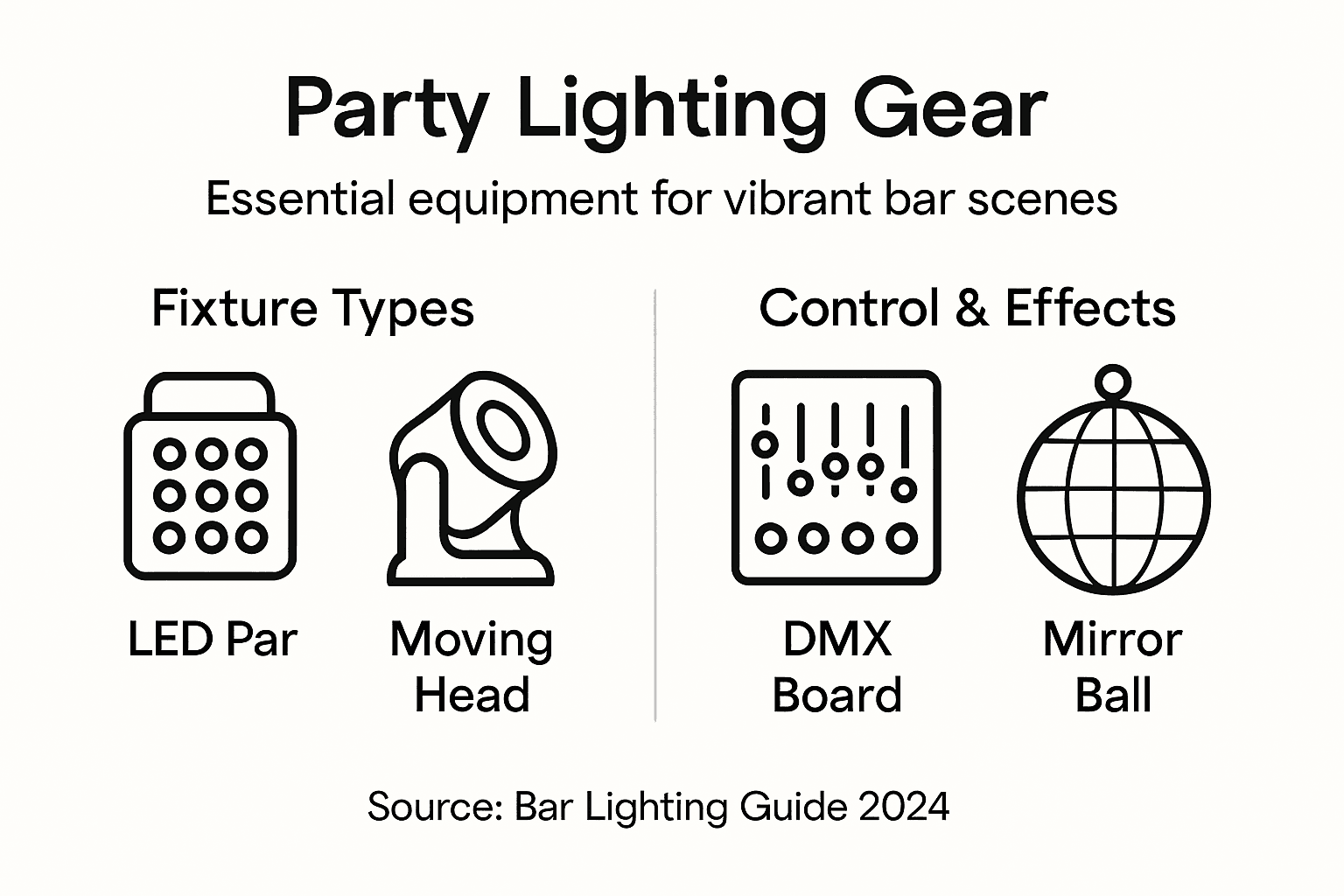
To help you select the most suitable lighting equipment, here is a comparison of common party lighting types and their advantages:
| Lighting Type | Ideal Use Case | Visual Impact | Flexibility |
|---|---|---|---|
| LED par lights | General ambience | Smooth colour washes | Highly adjustable |
| Moving head fixtures | Dance floor zones | Dynamic beam effects | Programmable |
| Laser lights | High-energy events | Sharp, vibrant beams | Moderate |
| Mirror balls | Retro/disco evenings | Reflective sparkle | Fixed pattern |
| Strobe lights | Musical highlights | Intense pulses | Manual/auto mode |
Pro tip: Invest in a modular lighting system that allows gradual upgrades and provides flexibility for different event styles.
Step 3: Plan lighting placement for ambience
Transforming your bar’s atmosphere requires strategic lighting placement that goes beyond simply illuminating the space. Careful lighting positioning can dramatically enhance the emotional experience of your guests and create distinct zones within your venue.
Begin by identifying key areas that require different lighting treatments:
- Dance floor – High-intensity, dynamic lighting
- Bar area – Softer, more focused illumination
- Seating zones – Warm, intimate lighting
- Entrance – Welcoming, transitional lighting
- Performance stage – Dramatic, directional lighting
Strategic lighting placement creates invisible boundaries and guides guest movement throughout your venue.
Implement lighting techniques that control spill and glare to ensure comfortable visual experiences. Consider using:
- Adjustable mounting brackets
- Directional fixtures
- Dimmer switches
- Colour-changing capabilities
- Programmed lighting sequences
Each lighting fixture should serve a specific purpose, whether creating depth, highlighting architectural features, or generating energy through movement and colour transitions. Professional bars often use layered lighting approaches that allow seamless mood transitions throughout different times of the evening.
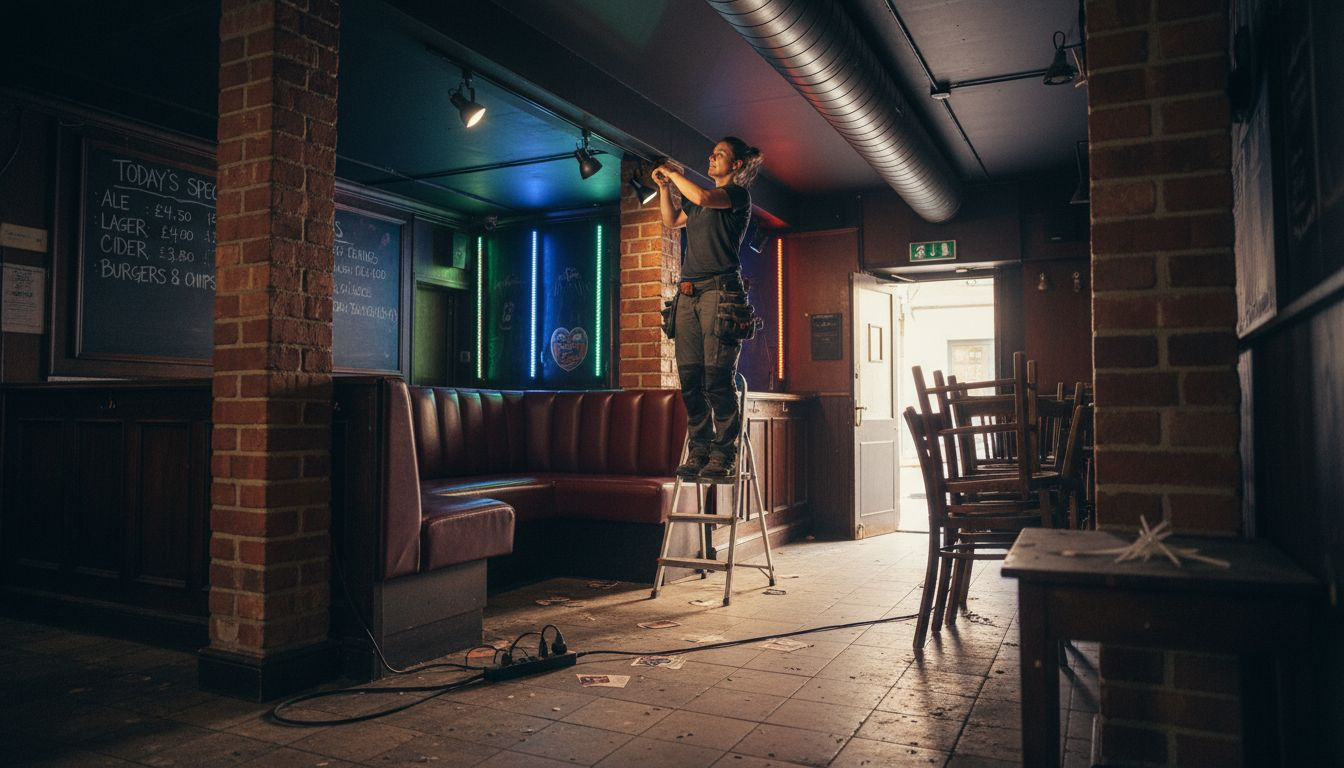
Here is a summary of lighting placement strategies for key bar areas to enhance ambience:
| Zone | Suggested Lighting Style | Desired Effect |
|---|---|---|
| Dance floor | Dynamic, high intensity | Energise guests |
| Bar area | Focused, soft illumination | Highlight drinks, serve safely |
| Seating zones | Warm, intimate lighting | Comfort social groups |
| Entrance | Welcoming, transitional | Guide arrivals |
| Performance stage | Dramatic, directional | Spotlight performers |
Pro tip: Create a basic lighting design sketch before installation to visualise how different fixtures will interact and complement each other.
Step 4: Install and connect all lighting fixtures
Installing lighting fixtures requires precision, planning, and a systematic approach to ensure safety and optimal performance. Careful installation following professional standards will guarantee your bar’s lighting system functions flawlessly and meets regulatory requirements.
Before beginning the installation, gather essential tools and equipment:
- Power drill
- Electrical screwdriver
- Wire strippers
- Mounting brackets
- Circuit tester
- Safety goggles
- Electrical tape
Professional installation minimises risks and ensures your lighting system operates safely and efficiently.
Follow these critical steps for successful lighting fixture installation:
- Turn off electrical power at the main circuit breaker
- Confirm voltage compatibility for each fixture
- Install sturdy mounting brackets securely
- Connect electrical cables using proper wiring techniques
- Test each connection before final mounting
Professional lighting installation guidance recommends having a qualified electrician verify complex wiring configurations. Pay special attention to cable management, electrical safety, and fixture stability.
Each lighting fixture should be mounted at the predetermined angles and locations identified in your earlier placement plan. Use adjustable brackets to fine-tune positioning and ensure optimal light distribution across different venue zones.
Pro tip: Label each cable and connection point during installation to simplify future maintenance and troubleshooting.
Step 5: Test and adjust lighting for effect
The final stage of your lighting installation involves meticulous testing and fine-tuning to create the perfect atmosphere for your bar. Comprehensive lighting evaluation requires systematic assessment of multiple sensory and technical parameters.
Begin your testing process with these critical evaluation points:
- Colour temperature and mood generation
- Intensity levels across different zones
- Colour accuracy and visual vibrancy
- Energy efficiency of lighting setup
- Glare reduction and visual comfort
Precise lighting adjustment transforms a standard venue into an extraordinary experience.
Follow a structured approach to testing and adjusting:
- Start with low-intensity settings
- Gradually increase light levels
- Test each fixture individually
- Observe colour mixing capabilities
- Check for uniform illumination
Lighting scheme fine-tuning involves continuous refinement. Pay attention to dynamic light transitions, shadow management, and mood progression throughout different times of the evening.
Consider recording video footage of your lighting setup to review subtle nuances and make precise adjustments that might not be immediately visible during live testing.
Pro tip: Invite a small test group to experience your lighting setup and provide candid feedback before final implementation.
Elevate Your Bar’s Party Lighting with Stunning Mirror Balls
Creating an unforgettable atmosphere in your bar means mastering the art of lighting placement and dynamic effects. The article highlights challenges such as balancing functional illumination with vibrant ambience, choosing adaptable lighting equipment, and designing strategic layouts that energise every zone from dance floors to seating areas. If you want to bring these concepts to life, adding high-quality mirror balls is a proven way to inject classic sparkle and movement, captivating your guests and enhancing the emotional impact of your lighting design.
Discover a wide selection of professional-grade and decorative mirror balls at Mirror-Balls.co.uk. Whether you aim to energise the dance floor or add subtle, retro shimmer above the bar, our range supports flexible installation options and mixes effortlessly with LED lights or strobes for spectacular effects. Start transforming your venue today by exploring our expertly curated collection, designed to meet varying scales and budgets. Don’t wait to create that signature party atmosphere that keeps visitors coming back — browse now at Mirror-Balls.co.uk and see how easy it is to enhance your lighting setup with mirror balls.
Frequently Asked Questions
How do I assess my bar’s lighting requirements?
Assessing your bar’s lighting requirements involves evaluating your venue’s layout, features, and the type of crowd you expect. Focus on room dimensions, colour schemes, and primary entertainment zones to create a tailored lighting strategy.
What types of lighting equipment should I select for my bar?
Select a mix of lighting types to cater to various moods and events at your bar. Consider using LED par lights for ambience, moving head fixtures for dynamic effects, and laser lights for high-energy dance moments to enhance the overall experience.
How should I plan the placement of lighting fixtures?
Plan your lighting placement by identifying key areas such as the dance floor, bar, and seating zones. Use strategic positioning to create distinct atmospheres and guide guest movement throughout your bar.
What steps are involved in installing lighting fixtures in my bar?
Installing lighting fixtures involves turning off electrical power, securely mounting fixtures, and connecting cables according to professional standards. Follow a systematic approach to ensure safety and optimal performance in your bar’s lighting system.
How can I test and adjust my bar’s lighting for the best effect?
Test your bar’s lighting by initially setting low-intensity levels and gradually increasing them while observing colour mixing and uniform illumination. Fine-tune your setup based on visual comfort and the desired mood for different times of the evening.
What are some common lighting placement strategies for specific bar zones?
Common lighting placement strategies include using high-intensity lighting on the dance floor for energy, softer illumination in the bar area to highlight drinks, and warm lighting in seating zones to create a comfortable atmosphere. Tailor your lighting to enhance the vibe of each area effectively.
Recommended
- 7 Essential Bar Lighting Upgrade Tips to Boost Ambiance – Mirror Balls
- Role of Lighting on Dance Floors – Impact for UK Nightclubs – Mirror Balls
- 7 Essential Club Lighting Tips for UK Event Planners – Mirror Balls
- Accent Lighting: Transforming UK Nightclub Atmosphere – Mirror Balls
- DJ Weihnachtsfeier München – Ihr Event DJ Für Firmen