Professional venues across britain rely on advanced lighting to shape unforgettable experiences, yet many still overlook the impact of efficient control systems. In fact, over 80 percent of stage productions now use digital protocols like DMX to coordinate complex lighting effects that were once impossible to achieve. Understanding how DMX lighting works and why it matters helps you choose smarter solutions for creative displays, whether you manage a local theatre, run events, or design visual installations.
Table of Contents
- What Is DMX Lighting And Its Purpose
- Main Types Of DMX Lighting Systems
- How DMX Lighting Works In Practice
- Typical Applications In Venues And Events
- Common Mistakes When Using DMX Lighting
- Choosing And Setting Up DMX Equipment
Key Takeaways
| Point | Details |
|---|---|
| Understanding DMX Lighting | DMX lighting is a digital communication protocol that enables precise control of complex lighting systems across various environments. |
| Diverse DMX Systems | There are various types of DMX lighting systems, including fixed colour fixtures, moving head lights, and wash lights, each designed for specific applications. |
| Typical Applications | DMX lighting is extensively used in theatres, concert venues, and architectural lighting to enhance visual experiences in professional and entertainment settings. |
| Common Mistakes to Avoid | Essential pitfalls include incorrect fixture addressing and inadequate cable management, which can lead to problematic lighting system behaviour. |
What Is DMX Lighting And Its Purpose
Digital Multiplex (DMX) represents a sophisticated communication protocol transforming lighting control across entertainment and professional environments. According to leducation, this standard enables robust, real-time lighting communication that bridges manufacturers’ controllers and receivers in the entertainment lighting industry.
At its core, DMX lighting allows precise electronic control of complex lighting systems through a standardised digital language. The protocol permits a single controller to send comprehensive data signals across multiple intelligent devices through one cable, offering unprecedented flexibility and efficiency. aact confirms this capability, highlighting how DMX facilitates standardised control across diverse settings from theatrical productions to commercial installations.
Key characteristics of DMX lighting include:
- Ability to control multiple devices simultaneously
- Real-time signal transmission
- Scalable communication architecture
- Compatibility across different manufacturers’ equipment
Whether you’re designing a nightclub ambience, choreographing stage lighting, or creating immersive architectural illumination, DMX systems provide the technological foundation for sophisticated, programmable lighting experiences. For those looking to explore DMX controllers in more depth, our DMX Controllers collection offers professional-grade options to elevate your lighting design capabilities.
Main Types Of DMX Lighting Systems
DMX lighting systems encompass a diverse range of fixtures designed to meet various performance and architectural lighting requirements. manual highlights several primary categories of DMX lighting, including general DMX fixtures, floodlights, moving heads, and specialised servo-controlled devices that can create intricate lighting effects.
The complexity and scale of DMX lighting systems vary dramatically. According to glopedia, lighting consoles range from basic models supporting a single 512-channel universe perfect for small venues to advanced systems capable of managing tens of thousands of channels across multiple universes, suitable for large-scale productions.
Key Types of DMX Lighting Systems:
- Fixed Colour Fixtures: Static lights with predefined colour options
- Moving Head Lights: Programmable units that can pan, tilt, and change colours dynamically
- Wash Lights: Wide-beam fixtures for creating ambient lighting effects
- Spot Lights: Focused beams for precise illumination and highlighting
For professionals seeking specific DMX controller solutions, our range includes precision options like the Transcension 6-Channel DMX Controller, which offers versatile control for various lighting setups. Whether you’re designing for a small theatre or a massive concert venue, understanding these DMX lighting system types is crucial for creating compelling visual experiences.
How DMX Lighting Works In Practice
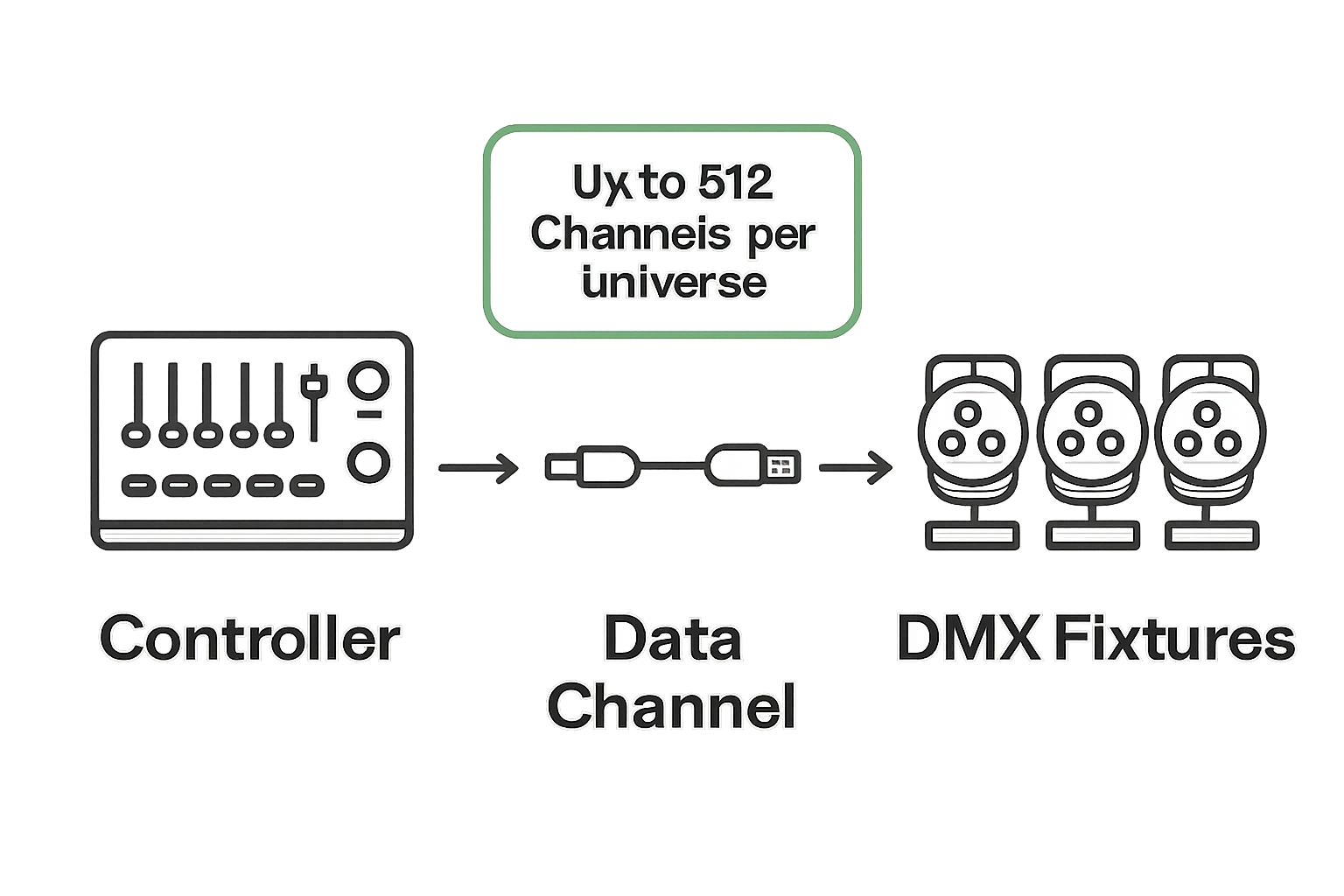
DMX lighting operates through a sophisticated digital communication system that enables precise control over complex lighting environments. en explains that DMX512 is a standard control protocol predominantly used in theatres, capable of transmitting data packets across XLR cables to manage dimmers and intelligent fixtures, with each cable run supporting up to 512 channels.
According to umatechnology, the core mechanism involves a controller sending digital signals to individual lighting fixtures. Each DMX channel corresponds to specific parameters like intensity, colour, pan, tilt, or gobo, allowing lighting designers to create intricate and dynamic lighting sequences with remarkable precision.

Practical DMX Lighting Control Process:
- Controller Initialisation: Setup of primary lighting control console
- Channel Assignment: Mapping specific functions to individual channels
- Signal Transmission: Digital data packets sent via XLR cables
- Fixture Response: Immediate adaptation of lighting parameters
For event professionals looking to enhance their lighting design capabilities, understanding these technical nuances is crucial. If you’re interested in exploring practical lighting techniques, our guide on choosing disco lights offers additional insights into creating memorable visual experiences.
Typical Applications In Venues And Events
DMX lighting systems have revolutionised illumination across numerous professional and entertainment environments. enocean-alliance highlights the protocol’s widespread adoption, identifying key venues including theatres, convention facilities, ballrooms, large restaurants, nightclubs, churches, and educational institutions where complex lighting setups are essential.
According to leducation, DMX technology has expanded beyond its original entertainment industry roots, gaining significant traction in commercial applications due to its remarkable flexibility, straightforward deployment, and robust performance characteristics.
Typical DMX Lighting Applications:
- Theatre Productions: Creating dynamic stage lighting and mood
- Concert Venues: Synchronising lights with musical performances
- Corporate Events: Professional presentation and branding environments
- Architectural Lighting: Enhancing building aesthetics and functionality
- Religious Ceremonies: Supporting ritualistic and ceremonial lighting requirements
For event professionals seeking to understand the transformative potential of lighting design, our guide on disco lighting advantages provides deeper insights into creating memorable visual experiences across diverse settings.
Common Mistakes When Using DMX Lighting
Professional lighting designers frequently encounter critical errors that can compromise their entire DMX lighting setup. umatechnology highlights three primary technical pitfalls: improper fixture addressing, inadequate cable management leading to signal degradation, and failure to properly terminate the DMX line, which can cause unpredictable lighting system behaviour.
en further elaborates on potential DMX lighting complications, emphasising that technical errors often stem from incorrect channel assignments, exceeding recommended device limits per DMX universe, and utilising damaged or inappropriate cabling that disrupts communication between controllers and fixtures.
Critical DMX Lighting Mistakes to Avoid:
- Incorrect Fixture Addressing: Misconfiguring device channel settings
- Unterminated DMX Lines: Neglecting proper signal termination
- Excessive Cable Lengths: Extending beyond recommended transmission distances
- Improper Cable Quality: Using low-grade or damaged connection cables
- Overcrowded DMX Universes: Connecting too many devices to a single network
For event professionals seeking to elevate their technical expertise, our guide to understanding disco lighting provides additional insights into creating flawless lighting experiences.
Choosing And Setting Up DMX Equipment
Selecting appropriate DMX equipment requires careful consideration of your specific lighting requirements. glopedia emphasises the importance of matching your equipment to the scale of your event, noting that entry-level consoles typically handle 1-2 universes for smaller venues, while advanced models support multiple universes for large-scale productions.
manual underscores the critical nature of precise fixture configuration, highlighting that successful DMX setup hinges on meticulously mapping each fixture’s DMX address to correspond with the controller’s channel assignments. This process demands a comprehensive understanding of your specific fixture requirements and their individual technical characteristics.
Key Considerations When Choosing DMX Equipment:
- Venue Size: Determine total number of DMX universes required
- Fixture Compatibility: Ensure controller supports your specific lighting fixtures
- Channel Requirements: Calculate total channels needed for your setup
- Future Scalability: Select equipment with potential for expansion
- Budget Constraints: Balance performance with cost-effectiveness
For professionals seeking robust DMX control solutions, our EasiLED 4 DMX Controller offers a versatile option for precise lighting management across various event environments.
Elevate Your DMX Lighting Setup with Professional Equipment from Mirror-Balls
Mastering DMX lighting systems demands more than just technical knowledge. Whether you are addressing complex fixture configurations or seeking precise control over multiple channels, the challenges of achieving flawless lighting scenes can be overwhelming. Common pitfalls like incorrect fixture addressing or poor signal termination can undermine your creative vision and disrupt your event’s atmosphere.
Experience true control and reliability by exploring our specially curated selection of DMX controllers and lighting accessories at Mirror-Balls. From the versatile Transcension 6-Channel DMX Controller to the user-friendly EasiLED 4 DMX Controller, our products are designed to help you build seamless, scalable lighting solutions for any venue size. Take your lighting design to the next level today by visiting mirror-balls.co.uk and discover how professional-grade equipment can transform your events with ease and precision.
Frequently Asked Questions
What is DMX lighting and how does it work?
DMX lighting is a digital communication protocol that allows precise control over complex lighting systems. It operates through XLR cables, transmitting data packets that manage various lighting parameters like intensity, colour, pan, and tilt, typically supporting up to 512 channels per run.
What are the main types of DMX lighting systems available?
The main types of DMX lighting systems include fixed colour fixtures, moving head lights, wash lights, and spot lights. Each type serves different purposes in performances and installations, ranging from ambient light to focused illumination.
What are common applications of DMX lighting?
DMX lighting is commonly used in various environments such as theatres for dynamic stage lighting, concert venues for synchronising lights with music, corporate events for professional presentations, architectural lighting for enhancing aesthetics, and religious ceremonies for supporting rituals.
What mistakes should I avoid when using DMX lighting systems?
Common mistakes to avoid when using DMX lighting systems include incorrect fixture addressing, neglecting to terminate DMX lines properly, using excessively long cable lengths, employing low-quality cables, and overcrowding DMX universes with too many devices connected to a single network.